
GEO Case Study: 8 Fixes in 10 Minutes
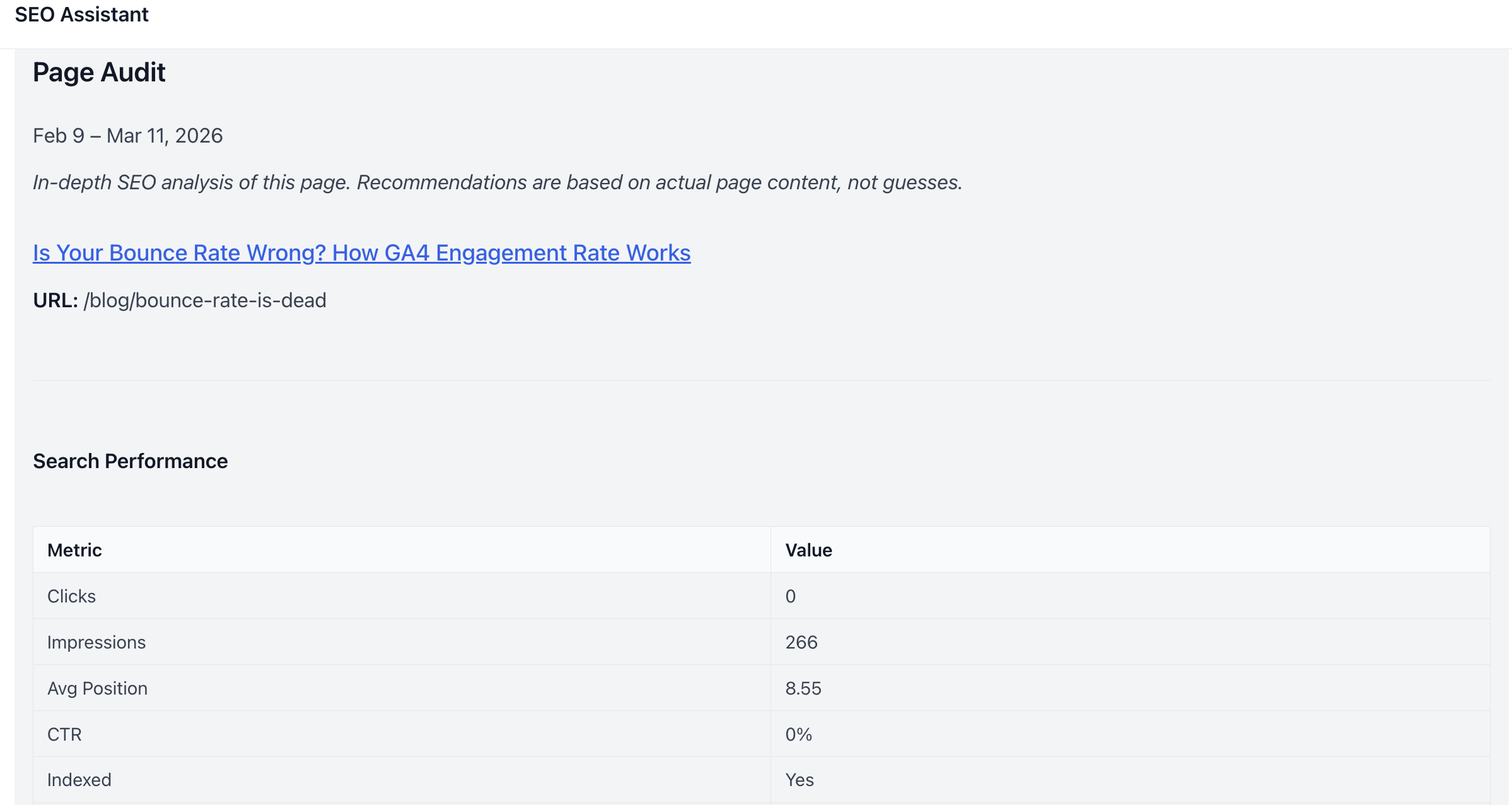
A page ranking in position 8.55 on Google with 266 impressions and zero clicks. Zero sessions. Zero AI referral traffic. A page that Google clearly considers relevant — but that nobody is clicking and no AI system is citing.
We ran two Brass-SEO reports on it — a Page Audit and an AI Citability report — and made eight changes in ten minutes. This is the before-and-after, with every fix documented.
For the complete GEO framework, see the Generative Engine Optimization guide.
Try it on your own pages
Brass-SEO runs both reports in seconds. Start your 3-day free trial — $25/month after that.
Quick Navigation
- The Page
- What Brass-SEO Found: Page Audit
- What Brass-SEO Found: AI Citability Report
- 8 AI Citability Fixes in 10 Minutes
- Why This Matters for GEO
- What Makes Brass-SEO Different for GEO
- GEO Glossary
- Frequently Asked Questions
The Page
The page is a guide explaining what happened when Google replaced bounce rate with engagement rate and how to read the new metric.
It is our own blog post on GA4 engagement rate — Bounce Rate Is Dead.
Before optimization:
| Metric | Value |
|---|---|
| Google Position | 8.55 (page 1) |
| Impressions (30 days) | 266 |
| Clicks | 0 |
| CTR | 0% |
| Sessions (30 days) | 0 |
| AI Referral Traffic | None detected |
| Indexed | Yes |
| Last Crawled | Feb 28, 2026 |
The page was indexed, ranking on page 1, and appearing for relevant queries like "google says bounce rate not used in ranking" — but nobody was clicking through, and no AI system was citing it. This is the exact gap that GEO addresses: a page that has search visibility but is not structured to earn clicks or citations.
What Brass-SEO Found: Page Audit
The Brass-SEO Page Audit identifies traditional SEO gaps by correlating Google Search Console impressions with GA4 session data — finding pages with high visibility but zero click-through. Here is what it flagged.
Strengths Identified
- Strong ranking potential: Position 8.55 for high-intent queries. Google views this content as relevant.
- Comprehensive structure: 10 H2 headings with a dedicated FAQ section. Good topical coverage.
- Title tag length: 56 characters — within the optimal range.
- Meta description: 153 characters — within the optimal range.
Problems Identified
1. CTR Crisis. 266 impressions, zero clicks. The SERP snippet is not compelling enough to earn clicks from a position 8 listing. The title "Is Your Bounce Rate Wrong? How GA4 Engagement Rate Works" reads like a generic how-to guide and does not differentiate from the dozens of other engagement rate articles.
2. Content Island. Zero sessions in 30 days means no internal traffic is flowing to this page. It is not linked from any high-traffic page on the site. Without internal links driving discovery, the page depends entirely on organic search — which is producing impressions but no clicks.
3. No Conversion Hook. The page educates thoroughly but never converts. There is no CTA connecting the reader to Brass-SEO's engagement rate analysis tools.
These three problems explain the zero-click, zero-session situation. The page is visible but not compelling, discoverable but not discovered, educational but not converting.
What Brass-SEO Found: AI Citability Report
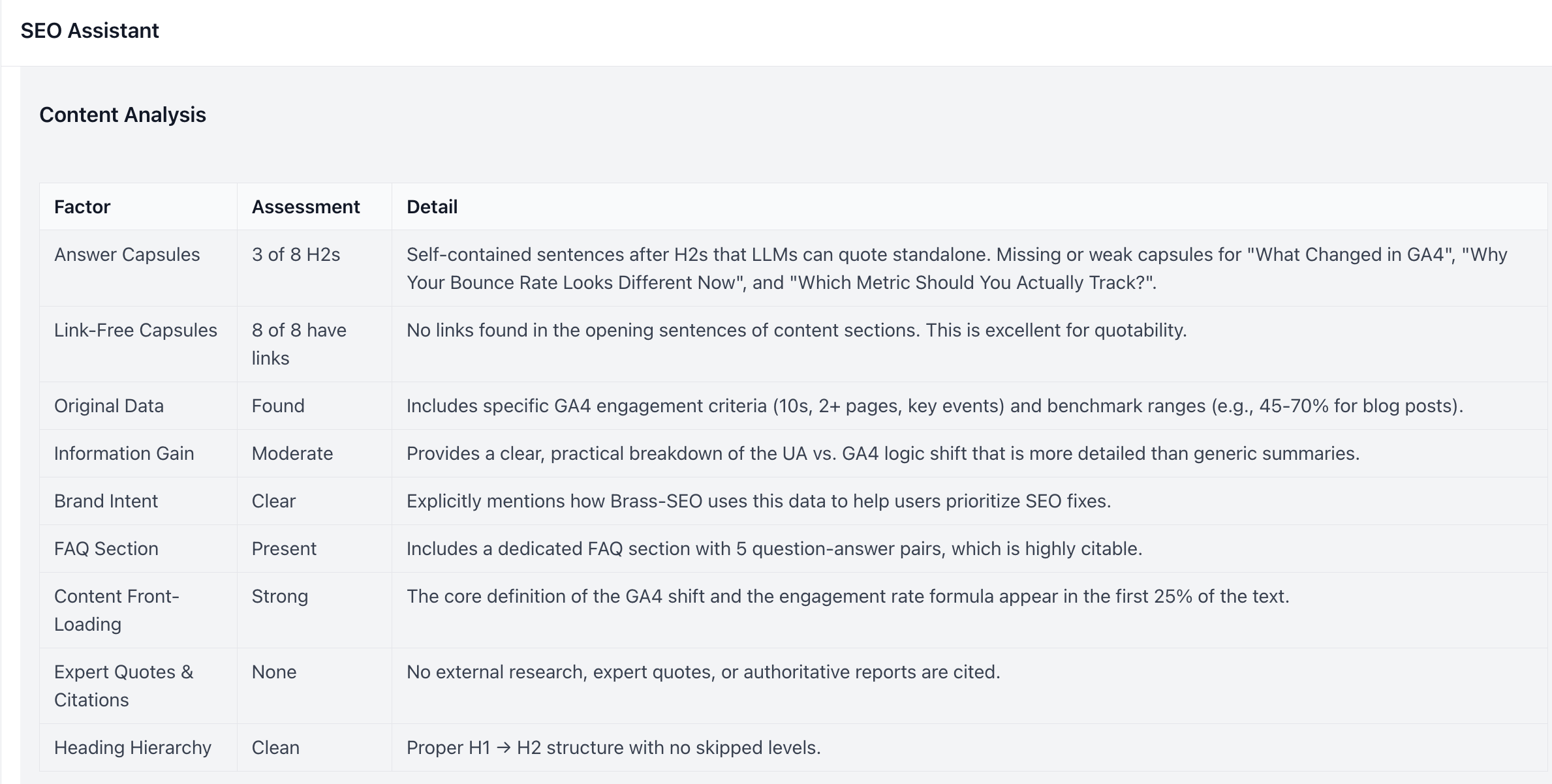
The AI Citability report evaluates how likely AI systems like ChatGPT, Perplexity, and Claude are to cite a page, checking it against nine structural and content factors derived from the Princeton GEO study and Gnuse's answer capsule research. (The audit has since added a tenth factor, scope clarity, after this case study was written.) See the full citability framework for details on each factor.
Citability Strengths
| Factor | Assessment |
|---|---|
| Link-free capsules | 8 of 8 content sections had no links in opening sentences |
| Original data | Specific GA4 criteria and benchmark ranges (45-70% for blog posts, sourced from Databox and Littledata surveys) |
| FAQ section | 5 question-answer pairs matching common AI query patterns |
| Content front-loading | Core definition appears in the first 25% of the page |
| Heading hierarchy | Clean H1 to H2 structure with no skipped levels |
| Brand intent | Brass-SEO mentioned by name |
Citability Problems
| Factor | Assessment |
|---|---|
| Answer capsules | Only 3 of 8 H2s had self-contained opening sentences. 5 used pointer language ("Here is how...") that makes no sense extracted from context. |
| Expert citations | Zero external expert quotes or research references. No authoritative validation. |
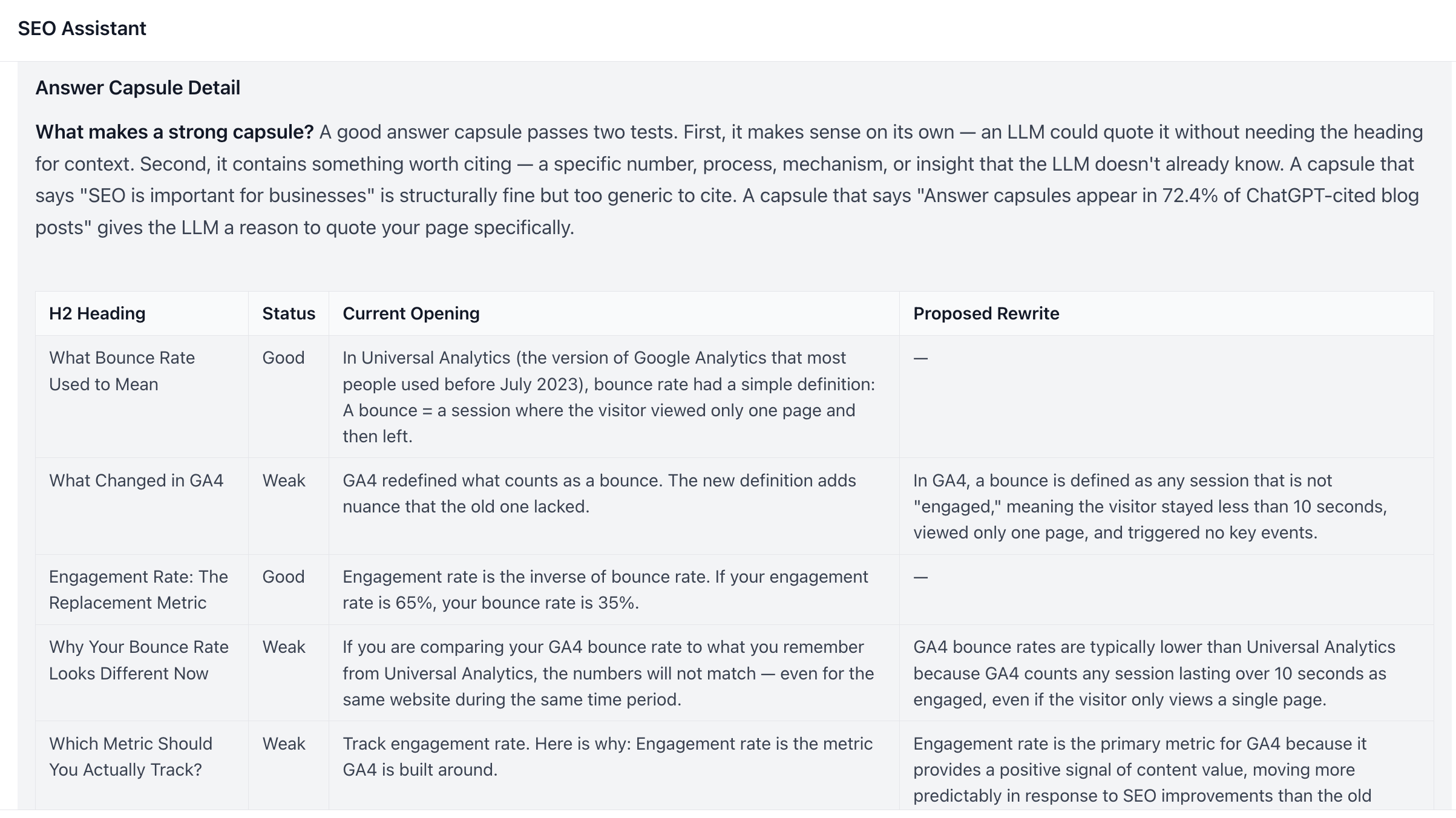
The tool did not just flag these problems — it proposed specific rewrites for each weak answer capsule.
Here are three examples:
"What Changed in GA4" — Before:
"GA4 redefined what counts as a bounce. The new definition adds nuance that the old one lacked."
This sentence is meaningless without reading the heading. An AI system quoting this passage gives its user no useful information.
"What Changed in GA4" — After (Brass-SEO's proposed rewrite):
"In GA4, a bounce is any session where the visitor stayed less than 10 seconds, viewed only one page, and triggered no key events."
This is a complete, self-contained fact. An AI system can quote it directly and its user understands the answer. This is what an answer capsule looks like.
"What Good and Bad Engagement Rates Look Like" — Before:
"There is no universal 'good' engagement rate because it varies dramatically by page type and industry."
Technically accurate but generic. Any AI system already "knows" that benchmarks vary. There is no reason to cite this page for that observation.
After:
"GA4 engagement rates vary by page type: long-form blog posts typically see 45-70%, while service pages fall between 40-65% (based on industry benchmarks from Databox and Littledata surveys)."
Specific benchmark data with a source. Worth citing.
8 AI Citability Fixes in 10 Minutes
Eight structural changes — rewriting opening sentences into self-contained answer capsules, adding an expert citation, and surfacing a hidden FAQ — took under 10 minutes total, with every fix coming directly from the two Brass-SEO reports.
From the Page Audit
| # | Fix | Why |
|---|---|---|
| 1 | Changed the title tag from "Is Your Bounce Rate Wrong? How GA4 Engagement Rate Works" to "Bounce Rate Is Dead. Here's What Replaced It." | CTR optimization. More provocative, differentiates from generic how-to results. |
| 2 | Added a conversion CTA after the "How This Affects Your SEO" section | The page educates but never converts. Added a direct link to the Brass-SEO dashboard with a clear value proposition. |
From the AI Citability Report
| # | Fix | Why |
|---|---|---|
| 3 | Rewrote "What Changed in GA4" capsule to a self-contained definition | 72.4% of ChatGPT-cited posts use answer capsules (Gnuse research). The old opener was pointer language. |
| 4 | Rewrote "Why Your Bounce Rate Looks Different Now" capsule with specific mechanism | Old opener ("the numbers will not match") said nothing quotable. New version explains exactly why GA4 rates are lower. |
| 5 | Rewrote "Which Metric Should You Actually Track?" capsule with a direct recommendation | Old opener ("Track engagement rate. Here is why:") requires the heading for context. New version stands alone. |
| 6 | Rewrote "How to Read Engagement Rate by Page" capsule with diagnostic framing | Old opener ("Here is how to use it") is a pointer. New version tells you what page-level analysis reveals. |
| 7 | Rewrote "What Good and Bad Engagement Rates Look Like" capsule with specific benchmarks | Old opener was generic ("it varies"). New version provides the actual ranges AI would want to cite. |
| 8 | Added an expert citation — Google's Gary Illyes on GA4 data not being used for rankings | The page had zero external validation. Adding an authoritative quote improves AI citation likelihood by up to 41% (Princeton GEO study). |
What We Also Added
- GEO glossary — consistent with our other GEO content, defining key terms (GEO, AEO, LLM Visibility, AI Citability, Answer Capsule, Engagement Rate)
- Quick Navigation update — added glossary to the anchor link list
- GEO guide link — connected this page into the GEO pillar content
Why This Matters for GEO
This page demonstrates the core GEO challenge: ranking on Google is not enough to get cited by AI.
The page was position 8.55 on Google. It was indexed. It was structurally sound. But it had zero AI referral traffic — because the content was not structured for extraction.
AI systems do not read pages the way humans do. They scan for passages they can extract, attribute, and present as part of a response. A sentence like "GA4 redefined what counts as a bounce" does not help an AI answer a user's question. A sentence like "In GA4, a bounce is any session where the visitor stayed less than 10 seconds, viewed only one page, and triggered no key events" does.
Research backs this up:
- 72.4% of blog posts cited by ChatGPT contain answer capsules — self-contained explanations after headings (Gnuse, Search Engine Land, 2025)
- 38% of pages ranking on Google's page 1 receive zero AI referral traffic (Gnuse, 2025)
- Adding expert quotes improves AI citation rates by +41% (Princeton GEO study, Aggarwal et al., 2024)
Five of the eight fixes we made came from the Brass-SEO AI Citability report. Without the Brass-SEO AI Citability report, we would have seen zero clicks and zero sessions but would not have known why — or that the fixes were as specific as rewriting opening sentences.
What Makes Brass-SEO Different for GEO
Most SEO tools tell you what is happening. Brass-SEO tells you what is happening and what to change for AI visibility.
Two Reports, One Complete Picture
The Brass-SEO Page Audit found the CTR crisis and content island problems — traditional SEO issues. The Brass-SEO AI Citability report found the structural problems that prevent AI citation — answer capsule weaknesses, missing expert validation. Together, they diagnosed every problem on the page in under 30 seconds.
No other $25/month tool combines both analyses. Enterprise tools like Ahrefs and Semrush track rankings and backlinks but do not audit content structure for AI citability. Dedicated AI tools check citations but do not connect to your actual GSC and GA4 data.
Specific, Actionable Fixes
The Brass-SEO AI Citability report does not say "improve your content." It says "This H2's opening sentence is pointer language — here is a self-contained rewrite." It evaluates each section against the nine citability factors and tells you which fixes will have the highest impact.
The $25/Month GEO Stack
Everything used in this case study runs on:
- Google Search Console (free) — provided the ranking data, impression counts, and keyword performance
- Google Analytics 4 (free) — provided the session data, engagement rates, and AI referral traffic
- Brass-SEO ($25/month, 3-day free trial) — ran both reports, identified every fix, and proposed capsule rewrites
Both GSC and GA4 are required. The data behind these reports is your data — Brass-SEO reads it with read-only access and never modifies anything in your Google accounts.
Start your free trial and run the same reports on your own pages.
GEO Glossary
The terminology around AI search optimization is still evolving. Here are the key terms used in this case study.
| Term | Full Name | What It Means |
|---|---|---|
| GEO | Generative Engine Optimization | Optimizing content so generative AI systems (ChatGPT, Perplexity, Claude) cite it. Coined by Princeton researchers (Aggarwal et al., 2024). |
| AEO | Answer Engine Optimization | Broader term that includes GEO plus traditional answer features like featured snippets and Google AI Overviews. |
| LLM Visibility | Large Language Model Visibility | Whether your content appears in LLM-generated responses. Used interchangeably with GEO in practitioner contexts. |
| AI Citability | — | How likely a page is to be cited by AI systems, based on structural and content factors. What Brass-SEO audits measure. |
| Answer Capsule | — | A self-contained explanation (1-2 sentences) placed immediately after a heading. The most common structural trait of AI-cited content (72.4%, Gnuse research). |
| AI Search | — | Umbrella term for any search experience powered by AI, including ChatGPT, Perplexity, Google AI Overviews, and Claude. |
Frequently Asked Questions
How long will it take to see results from these changes?
It depends on the platform. Perplexity searches the web in real time, so structural improvements can appear in Perplexity citations immediately. Google AI Overviews reflect index changes within days to weeks. ChatGPT's training data updates periodically over months. The CTR improvement from the title change should be visible in Google Search Console within 2-4 weeks. For the full tracking guide, see How to Track Whether AI Is Citing You.
Can Brass-SEO make these fixes automatically?
Brass-SEO identifies the problems and proposes specific fixes, but you make the changes to your own content. The tool reads your data with read-only access — it does not modify your website or your Google accounts. The proposed capsule rewrites are suggestions based on the citability framework.
Does this work on any page or just blog posts?
The Brass-SEO Page Audit and AI Citability reports work on any page that is part of your connected domain. Service pages, product pages, landing pages, and blog posts can all be audited. The nine citability factors apply to any content that you want AI systems to cite.
What if my page is not ranking on Google at all?
The Page Audit will still analyze your content and identify structural issues. However, GEO and traditional SEO are additive — pages that rank well in Google are more likely to be cited by AI systems (62% overlap). If your page is not ranking, focus on traditional SEO first, then layer GEO optimization on top. See How to Tell If Your SEO Is Working for the fundamentals.
How much does Brass-SEO cost?
$25/month with a 3-day free trial. Both Google Search Console and Google Analytics 4 are required (both free). No other tools are needed. Start your free trial.
How powerful is the Brass-SEO AI Citability button?
The Brass-SEO AI Citability button delivers a complete, actionable audit in seconds — not vague suggestions, but specific rewrites you can copy and paste. It identified every weak answer capsule on our page, proposed replacement text for each one, flagged the missing expert citation, and caught the invisible FAQ problem that schema-only markup creates. Every fix in this case study came directly from what the tool reported. Most pages need 10-30 minutes of changes after a single audit. No other tool at any price point combines citability analysis with your actual Google Search Console and GA4 data in one report.