
Original Data SEO: Real Results from a Case Study
Most SEO content competes on identical information. The same Semrush exports, the same Google studies, the same industry reports — rewritten in a slightly different order. Every page targeting "best practices for X" is fighting every other page targeting "best practices for X" on the exact same ground.
Original data posts are structurally different. They contain findings no competitor has, because the underlying records belong to you. We recently published two data-driven posts for a sister brand using six months of production database records — no surveys, no extrapolation, no estimates. This is a breakdown of what we did, how we did it, and what it means for any business sitting on data they haven't thought to publish yet.
Quick Navigation
- What "Original Data" Actually Means
- Why Original Data Posts Rank Differently
- The Case Study: BrassTranscripts 2026 Data Posts
- What the Data Posts Contained
- How to Find Original Data in Your Own Business
- Brass-SEO and the Data Already in Your Google Accounts
- Frequently Asked Questions
What "Original Data" Actually Means
Original data for SEO means publishing findings from records your business already generates — transaction logs, usage patterns, customer behavior signals — that no competitor has access to and no AI system can summarize from existing sources.
This is different from the content most businesses publish. Derivative content synthesizes what others have already published — useful, but easily displaced by whoever writes a longer version next month. Survey data asks customers or peers questions, but the answers are a layer removed from observed behavior. Original data analyzes what your system actually recorded. Nobody can replicate it because your database is not publicly available.
The SEO mechanic is direct: uniqueness is not just a quality signal, it's a citation signal. AI systems like ChatGPT and Perplexity, journalists covering your industry, and bloggers writing roundups all need to cite a primary source. If you are the primary source — because you own the data — you become structurally uncopyable.
A 2025 analysis by AI research group Zyphra found that 72.4% of pages cited by ChatGPT use structured answer capsules — a clear, standalone finding followed by supporting detail. Original data posts are the natural habitat for that format: a specific finding, stated cleanly, with the source identified.
Why Original Data Posts Rank Differently
Pages built on original data earn three structural SEO advantages that generic content cannot replicate: they attract inbound links as primary sources, they surface in AI-generated answers as facts outside any training dataset, and they resist competitive displacement because the underlying data cannot be copied.
Backlinks go to primary sources
When a journalist or blogger writes about trends in your industry, they need to cite whoever has the actual numbers. If your post is the only place those numbers exist, you are the citation. Generic posts compete with every other generic post on the same topic. Data posts anchor a citation network — they become the source that other content points to rather than the content that points elsewhere.
AI search can only cite what it doesn't already know
Large language models are trained on historical data with a cutoff date. A post published this month, using production records from the last six months, contains facts that weren't in any training set when the model was built. When someone asks an AI system about trends in your market, your page is one of the few sources with current, primary data — which increases the probability of being cited rather than paraphrased or ignored.
This is the same principle behind AI citability optimization: structure your content so AI systems can extract and repeat it. Original data gives you a structural advantage before you even consider formatting.
No competitor can replicate it
A competitor can write a longer version of your guide, match your keyword density, copy your heading structure. They cannot publish your production database records. They could publish their own original data — which would be a different post — but they cannot publish yours. The content has a natural moat that compound over time.
The Case Study: BrassTranscripts 2026 Data Posts
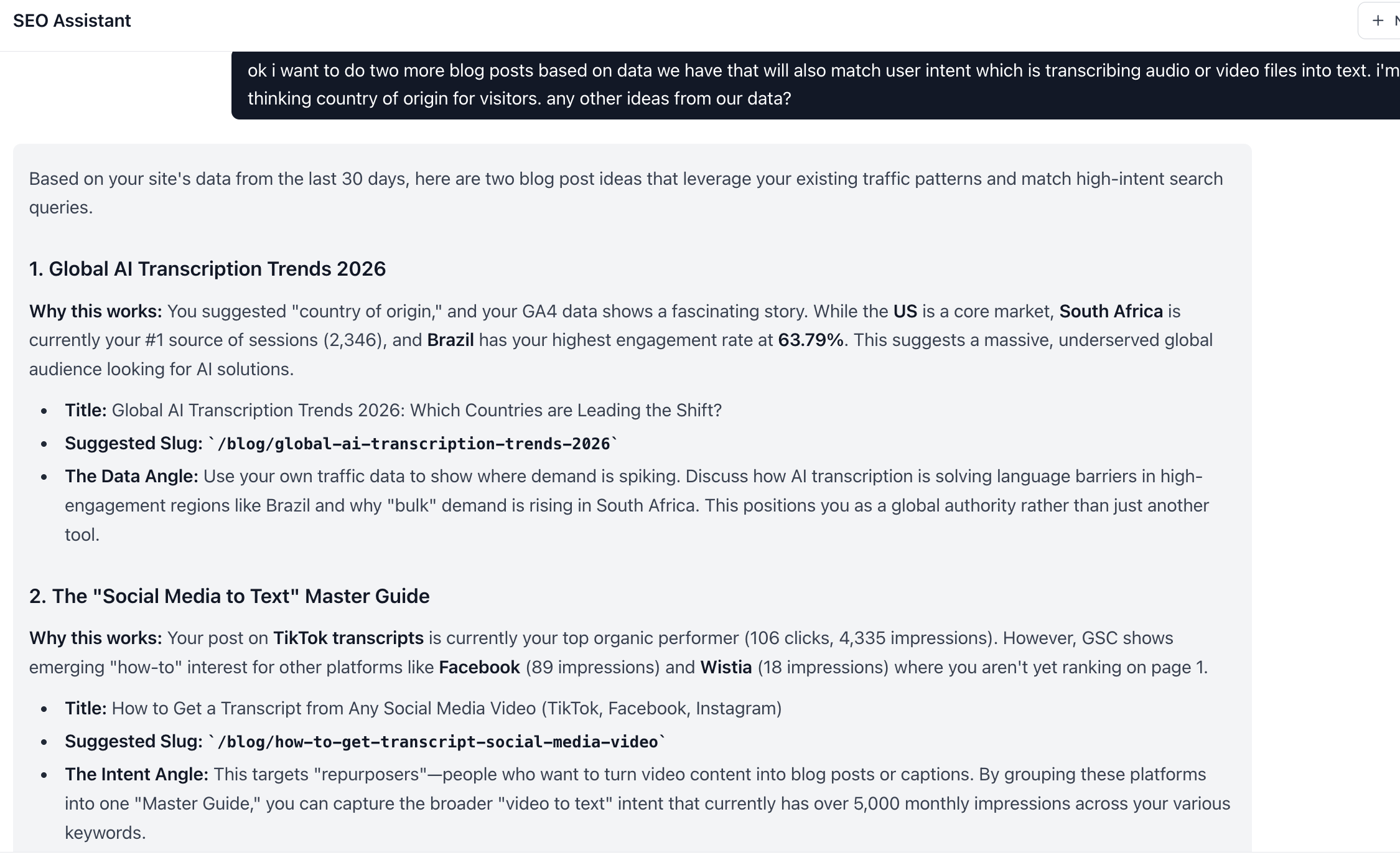
BrassTranscripts published two data posts in May 2026 built entirely from their production database — 580 completed transcription jobs totaling 252 hours of audio over a six-month window, with no surveys, no estimates, and no extrapolation from industry reports.
The data source was their job tracking system. Every transcription order generates records for file duration, file format, speaker count (identified by AI diarization), language, and pricing tier. Six months of those records became the raw material for both posts.
Global AI Transcription Trends 2026 515 paid jobs, 252 hours, 30 languages. Findings included language distribution (English at 63%, Portuguese driving most non-English volume), and the non-obvious pattern that Norwegian Nynorsk averaged 96.9 minutes per file with 8.19 speakers per recording — a signature of institutional usage, not consumer demand. That finding wouldn't appear in any industry survey because no one thinks to ask about it.
Transcription Buyer Patterns 2026: Data from 580 Real Jobs 580 jobs analyzed for behavioral patterns. The median file was 5.3 minutes, 2 speakers, M4A format — a voice note or short interview, not the corporate meeting most people imagine. Five buyer archetypes were identified from duration and speaker count combinations, without collecting a single survey or asking a customer their use case.
Both posts acknowledged their limitations explicitly: no customer identity linking, no geographic data, no use-case labels. That transparency is part of what makes the data credible.
What the Data Posts Contained
Each post led with the data source, stated the methodology and limitations honestly, identified patterns not visible from the raw numbers, and drew actionable conclusions — the structure of academic research, written for a business audience.
The dataset. Exactly how many records, what time period, and what was and wasn't tracked. BrassTranscripts stated upfront: 580 jobs, 252 hours, 6 months, no customer attribution, no geographic data. Specificity builds credibility. Vague sourcing ("we analyzed hundreds of jobs") does not.
The headline findings. Specific numbers that answer a clear question. Not "most files are short" — 49% of jobs were under 5 minutes. Not "English is dominant" — English represented 63% of job volume. Precision is what makes a finding citable.
The non-obvious patterns. This is where data posts earn their differentiation. Norwegian Nynorsk was third by hours despite being ninth by job count. That discrepancy — 16 jobs producing 22.6 hours, versus Portuguese producing 22.4 hours from 85 jobs — revealed that Nynorsk users were submitting long institutional recordings. A survey would never surface that. Only behavioral records show it.
Acknowledged limitations. What the data can't tell you matters as much as what it can. Customer identity wasn't linked across jobs, so repeat buyers couldn't be distinguished from new customers. Use-case labels weren't collected, so archetypes were inferred from behavioral signals, not stated intent. Honest limitations make findings more credible — they signal that the researchers understand the boundaries of their data.
Actionable conclusions. The data leads somewhere. The language post concluded with a localization priority order: Portuguese first, then French, Italian, Spanish, and Dutch, with Arabic, Russian, and German representing professional B2B segments. That recommendation came from the records, not from intuition.
How to Find Original Data in Your Own Business
Most businesses generate publishable original data already — they just don't recognize it as research material. The question is whether your records contain patterns that answer a question someone is actively searching for.
Three questions to ask:
What does your system log that has a pattern? File uploads, order records, booking times, support ticket categories, document types. Any system that accumulates records over time contains behavioral data. Six months of that data is a substantial sample for most small businesses.
What question in your industry gets answered by surveys — and could you answer it with observed behavior instead? Survey data is everywhere. "43% of marketers say they plan to increase AI spending" is what people said, not what they did. If your records show what customers actually did, that's more credible than any survey — and it's unique to you.
Can you publish it without exposing customer information? The BrassTranscripts posts published aggregate patterns — percentages, medians, distributions — not individual records. No customer name or file was identifiable. If your data can be described at the population level, it's publishable without privacy concerns.
Examples by business type:
| Business | Original data available |
|---|---|
| Law firm | Document types, matter categories, turnaround patterns |
| E-commerce | Cart abandonment by category, return reasons by SKU |
| Service business | Inquiry-to-booking rate by day and source |
| SaaS product | Feature usage frequency, session length distribution |
| Freelancer | Project type mix, revision patterns, delivery timing |
The data doesn't need to be exotic. It needs to be specific, honest, and sourced from records only you have.
Brass-SEO and the Data Already in Your Google Accounts
Brass-SEO surfaces the original data already inside your Google Search Console and Google Analytics accounts — query patterns, page-level engagement signals, striking-distance keywords — which become the raw material for data-driven posts about your own market and audience.
GSC and GA4 together contain something most businesses haven't thought of as publishable research: months of actual search behavior from real visitors to their specific site, in their specific market. That's not a generic industry benchmark. It's your data, and no competitor has it.
A business with six months of GSC data can publish: "We analyzed search queries to our [industry] blog over six months. Here's what people are actually looking for." The Brass-SEO Content Gaps button identifies queries earning impressions without a matching post. The Brass-SEO Winning Keywords button shows where you're within striking distance of page 1 — a finding that comes from your account, not from a shared keyword tool that estimates everyone's data equally.
The Brass-SEO AI Citability button analyzes individual pages for AI citation readiness — checking whether content is structured so LLMs can extract and quote specific findings. Used alongside a data-driven post, that analysis identifies which findings need to be reformatted as clean answer capsules before the post goes live.
Original data gives you the raw material. Structure determines whether search engines and AI systems can find the signal in it.
Frequently Asked Questions
Does original data only work for businesses with large datasets?
No. BrassTranscripts published meaningful findings from 580 jobs over six months — a sample size most small businesses could reach within a year of operation. The threshold isn't volume, it's pattern stability. If your findings change materially every time you add 10 records, the sample is too small. If patterns hold across the full dataset, you have publishable research regardless of the absolute number.
How do I publish original data without exposing customer information?
Publish aggregates, not records. Every finding in the BrassTranscripts posts described population-level behavior: percentages, medians, distributions. No individual customer's file was identifiable. If your data can be described at the population level — "49% of orders were under $25" rather than "Customer X placed a $22 order on March 3" — it's publishable without privacy concerns.
Will an original data post rank immediately?
No. Original data posts rank for the same reasons other pages rank — relevance, quality, and authority. The structural advantage is durability: once a data post ranks, it's difficult to displace because a competitor cannot publish a better version of your data. They could publish their own data, which would be a separate post. The moat compounds over time.
What if the data shows nothing interesting?
Publish it with honest framing. "We analyzed X and found no clear pattern" is a genuine research finding. Researchers who force narratives onto inconclusive data lose credibility quickly. A post that says "we expected Y but found no evidence for it" still produces unique content, and the honesty signals the kind of authority that earns links and citations.
How does original data help with AI search specifically?
AI systems are trained on historical data. A post using your production records from the last six months contains facts that weren't in any training set when the model was built. When an AI is asked about trends in your industry, your post is one of the few sources with current, primary data — which increases the probability it gets cited rather than paraphrased or ignored. For a deeper look at how this works, the GEO research post covers the underlying mechanics of AI citation patterns in detail.
Find the original data already in your site
Brass-SEO reads your Google Search Console and GA4 accounts and surfaces patterns in your search queries, content gaps, and page performance. Start your free trial — no data export or spreadsheet required.